ChessBase Magazine
The fortress
Opposite coloured bishops and two extra pawns (I)
by Dorian Rogozenco
Video introduction
In this issue, Dorian Rogzenco begins a new series on fortresses in which one side has two connected extra pawns whilst the bishops are of opposite colours. The first motif you will encounter here is fairly straightforward to understand. Specifically, the fortress looks like this:
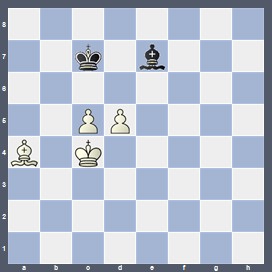
White’s extra pawns are on the fifth rank along the c- and d-files, and the black pieces have occupied the fortress squares c7 for the king and e7 (or f8) for the bishop. This position is simply a draw because White cannot make any progress. In response to 1.c6, Black could, for example, establish a black-square blockade with 1...Bd6. After 1.d6+, Black sacrifices his bishop for the two pawns with 1...Bxd6. And should White, for example, interpose a waiting move such as 1.Bb5, Black can counter this with 1...Bf8 (only this move maintains the fortress, as it keeps control over the d6-square and also keeps an eye on the pawm on c5). It is also important to note that the fortress only works if the pawns are still on the fifth rank. If the pawns had already advanced to the sixth rank, the defender would be lost! If the extra pawns have been moved to other files, e.g. the d- and e-files, the way the fortress works remains unchanged.
An important practical tip is for the defender to wait until both extra pawns have reached the fifth rank before taking up the fortress position. If one of the pawns is still on the fourth rank, the attacking king has additional options – as in this position from the Lammers–Dinstuhl game (Bundesliga 2016):
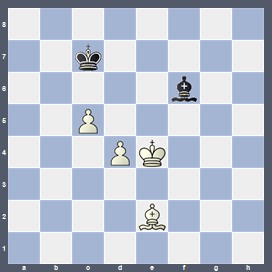
Black played 1...Bg7 – a logical and good move that keeps an eye on the lagging pawn. The aim is to tempt White into advancing the pawn to the fifth rank – the game ended quickly in a draw.
1...Be7 would also have been correct, but Black must not allow himself to be lured into simply shuffling his bishop back and forth between e7 and f8 – as if the fortress had already been built! Otherwise, after 2.Bb5 Bf8 3.Kd5 Be7 4.Ke6, White can force this position:
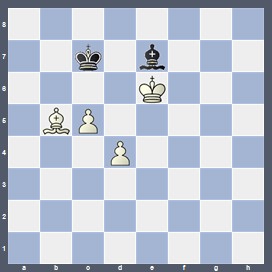
The obvious 4...Bf8? now loses due to 5.Kf7 Bh6 6.d5 Bf4 6.Ke6!
However, Black can still save the game by retreating the king with 4...Kd8 (instead of 4...Bf8), as after 5.Ba4 Bf8 6.Kf7 Bh6 7.d5 Be3 the king is not exposed to check by the d5-d6 advance – an important detail that shows things are not always quite so simple!
Interactive training videos
Dorian Rogozenco’s contribution consists of a 15-minute introductory video as well of five interactive training videos in which you receive feedback on the moves that you enter.
What would you play here with Black?
It is Black's turn to play - make the right move!
Play like Anish Giri - with the black pieces!
How would you Play here with Black?
Try to find the winning move for White!